
Table of Contents
The planned metro route in Gurgaon is part of the 28.5-kilometer GMRL corridor connecting Millennium City Centre to Cyber City via 27 stations. Construction of Phase 1 began in early 2025, after it was completed on the 5th of September 2025. Trial runs will begin in 2027. An 1.85 km spur linking Basai towards the Dwarka Expressway is also included in the proposed project.
That’s the simple answer.
Let us now go through all of the details — the entire route, all phases, and including the Dwarka Expressway spur and what it will mean for buyers of property across Gurgaon.
What Is the Upcoming Metro Route in Gurgaon, and Who Is Building It?
The Upcoming Metro Route in Gurgaon: GMRL’s 28.5 km Loop
The new metro line planned for Gurgaon is officially referred to as”the Gurugram Metro Rail Limited (GMRL) corridor. The GMRL corridor is a collaborative initiative by government officials from the Central Government and the Haryana Government and is being implemented through the Haryana Mass Rapid Transport Corporation (HMRTC). Haryana Mass Rapid Transport Corporation (HMRTC).
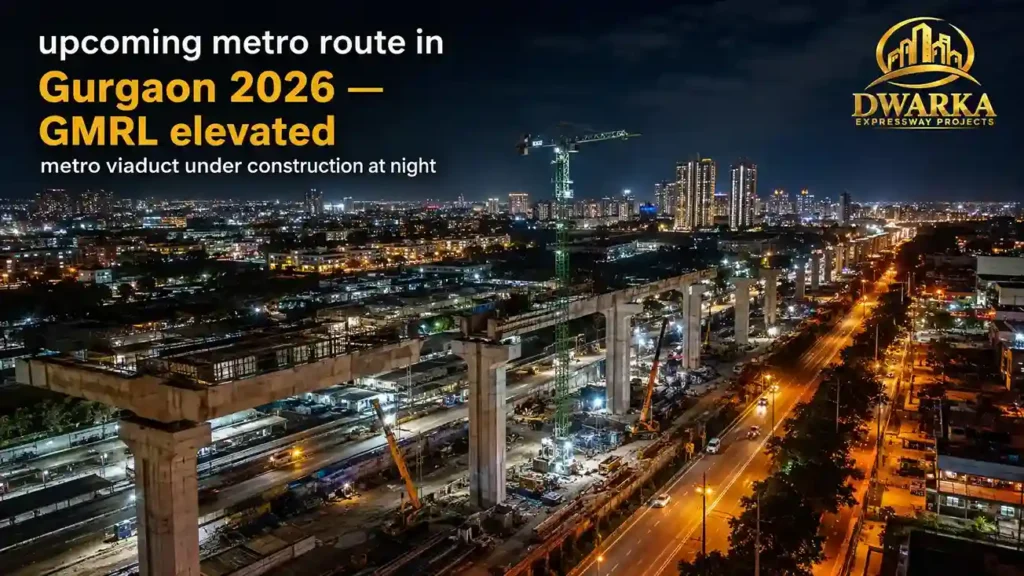
This isn’t a plan on paper. Construction has begun in 2026.
The route is planned in the form of an elevated loop, approximately 28.5 km in total, that connects Millennium City Centre (MCC) on the south and Cyber City on the north. The loop passes via Old Gurgaon, Palam Vihar, as well as a number of commercial and residential areas that have been without railway connectivity for years.
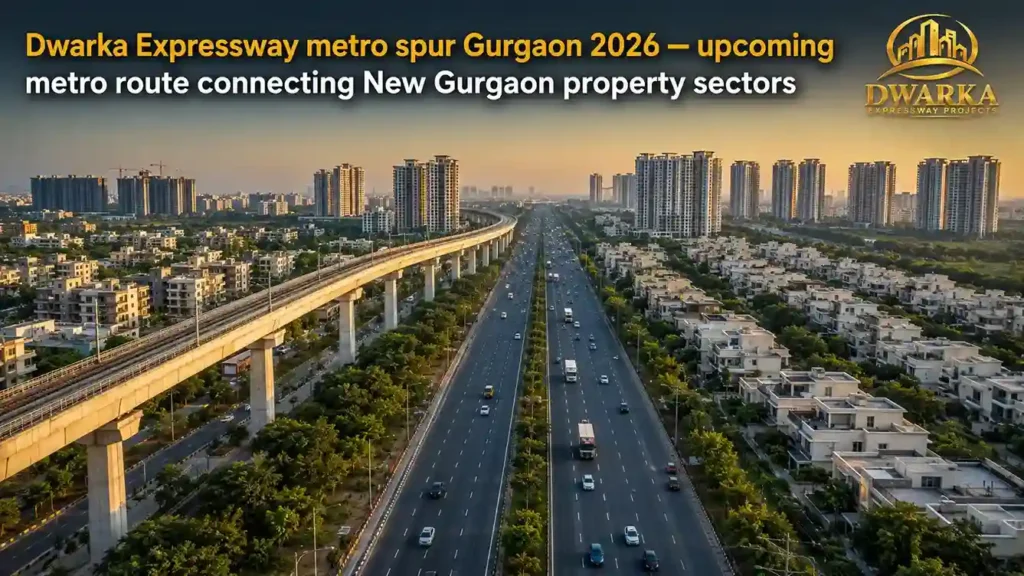
Additionally, there is the Metro line that is scheduled to be built in Gurgaon, comprising the 1.85-kilometer spur line that runs from Basai Village to Sector 101 on the Dwarka Expressway. This spur opens the New Gurgaon expressway belt for the first time.
Project’s most important facts:
| Detail | Data |
|---|---|
| Total route length | 28.5 km (loop) + 1.85 km spur |
| Total stations | 27 stations |
| Executing body | Gurugram Metro Rail Limited (GMRL) |
| Cost of the project | Rs5,452.72 crore |
| Phase 1 length | 15.2 km |
| Phase 2 length | 13.3 km |
| Foundation stone | 5 September 2025 |
| Trial run target | Early 2027 (Phase 1) |
| Full operation | 2027-28 |
Phase 1 of the Upcoming Metro Route in Gurgaon: Where Construction Is Happening
1. Phase (15.2 miles): Millennium City Centre to Sector 9
The initial phase of the metro line that is scheduled to be built in Gurgaon will run 15.2 kilometers, beginning at Millennium City Centre to Sector 9 in Old Gurgaon.
This stretch is comprised of the most densely populated, yet least metro-served regions within the city. Sectors 3, 5, 7, 9, 10, 22, 23, as well as Ashok Vihar — all of which are not served by direct rail access to the employment hubs — are included in this segment.
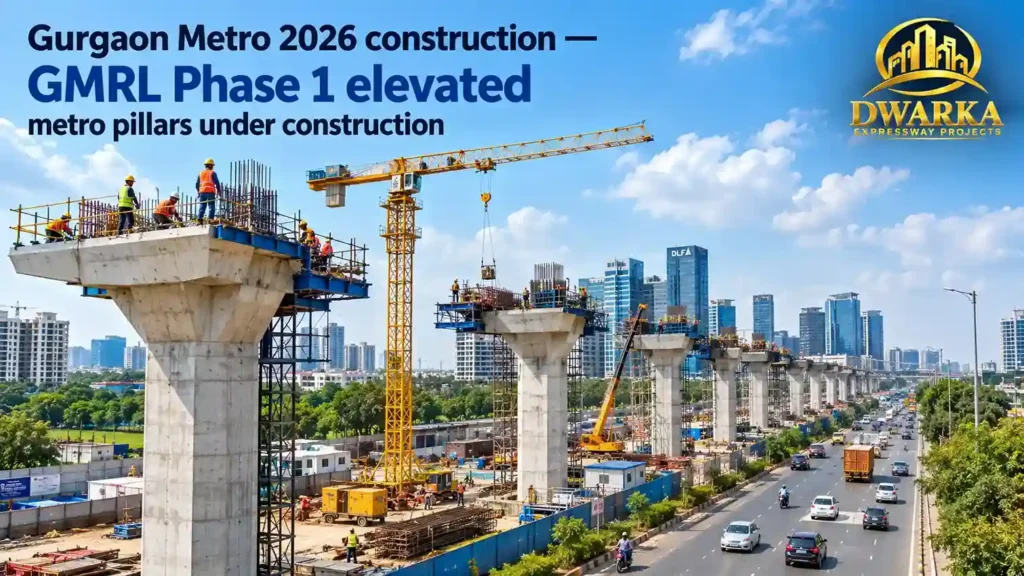
The construction status in 2026 is ongoing and in progress. The first pile foundation was laid in Sector 45 at the end of 2025. Pillar construction can be seen in the central portion that runs along Neki Ram Marg. Construction is also in progress close to Subhash Chowk in Old Gurgaon.
Furthermore, contractors for civil construction have mobilized equipment across several areas simultaneously. The GMRL has stated that it will be aiming for the pre-construction and design completion date prior to the monsoon season every year.
2. (13.3 miles): Sector 9 to Cyber City
The second section of the Metro line that is scheduled to be completed in Gurgaon is 13.3 kilometers, beginning at Sector 9 and going back to Cyber City, and completing the loop.
The first phase of tenders is now open for phase 2 civil works were set to begin in 2026. In the meantime, GMRL has already concluded the land designation for the major stations located in this section.
Furthermore, Phase 2 links Udyog Vihar Phase 6 -one of Gurgaon’s biggest office and industrial areas – straight to a metro system. This means that this phase will see a significant increase in commuter traffic starting the day it opens.
Upcoming Metro Route in Gurgaon: Complete Station List
27 Stations on the Gurgaon Metro Route 2026
The planned metro line in Gurgaon will provide service to 27 stations along the 28.5 km loop. This is the breakdown of sectors by sector.
Stations in Phase I (MCC from Sector 9): Millennium City Centre (interchange with Delhi Metro Yellow Line), Sector 45 to Sector 47 (Subhash Chowk), Sector 47 (Subhash Chowk), Palam Vihar Extension – Sector 22 – Sector 9 and the adjacent residential areas
Stage 2 stations (Sector 9 through Cyber City): Hero Honda Chowk, Sector 33 (future RRTS interchange); Udyog Vihar Phase 6, Sector 18, Cyber Park – Cyber City (interchange with Rapid Metro)
Dwarka Expressway Spur: Basai Village – Sector 101 (Dwarka Expressway)
Summary of Interchange:
| Station | Interchange |
|---|---|
| Millennium City Centre | Delhi Metro Yellow Line |
| Cyber City | Rapid Metro Gurgaon |
| Sector 33 (Hero Honda Chowk) | Future RRTS (planned) |
| Basai Village | Dwarka Expressway Spur |
The interchange network is extremely crucial. This means that residents of Old Gurgaon will be able to access Cyber City, Golf Course Road, as well as the Delhi Metro Yellow Line, and eventually, the RRTS throughout the Metro route that is planned for Gurgaon without having to change vehicles several times.
The Dwarka Expressway Spur: The Most Important Part for Property Buyers
How the Upcoming Metro Route in Gurgaon Connects New Gurgaon
The 1.85 km extension from Basai Village to Sector 101 on the Dwarka Expressway is the most important aspect of the coming metro line in Gurgaon for property owners.
Here’s why.
At present, the entirety of the Dwarka Expressway area of residential sectors 82A, 84, 88A, 99, 89, 101, 103, 106, and 108 does not have metro connectivity. Residents commute to the closest metro station, which can add 20-30 minutes to a metro commute.
The Basai spur alters this. Once it is operational, it will create an unimpeded rail link that connects:
- Sector 101 (Dwarka Expressway) – Basai – GMRL Main Line – Millennium City Centre (Delhi Metro)
- Sector 101 – Basai – GMRL Main Line – Cyber City (Rapid Metro)
Thus, a homeowner living in Victory Floors Sector 89 or Victory Floors Sector 88A — both located close to the Dwarka Expressway belt—will benefit from significantly greater access to the metro than any other point during the last ten years.
GMRL’s interim agreement: Skywalks and feeder bus services that connect Dwarka Expressway sectors to the Basai station will be in operation in Phase 1. Metro access directly via Sector 101 station is available after the spur is operational.
Why the Upcoming Metro Route in Gurgaon Is a Major Infrastructure Event
Gurgaon’s Rail Gap: What the New Metro Route Solves
To better understand why the coming metro line in Gurgaon is important, take a look at what is in place today.
Gurgaon currently has:
- 5.3 kilometers of Delhi Metro Yellow Line (5 stations) — which serves MG Road and Golf Course Road
- 11.7 kilometers from Rapid Metro (11 stations) — which serves Cyber City and Golf Course Road sectors.
This means that the majority of Gurgaon—Old Gurgaon, Palam Vihar, Sohna Road, Dwarka Expressway, New Gurgaon — has no metro connection in any way.
The GMRL Metro Line that is planned for Gurgaon will directly address this. 28.5 kilometers of brand-newly constructed rail, with 27 brand-new stations and a spur towards an expressway belt, all in one project.
Additionally, daily projections of ridership are very strong: 5.34 lakh riders per day when the operation begins and rising to 10.70 lakh in 2051. These figures confirm real commuter demand and not speculation about infrastructure.
Specifications for trains:
- Modern CBTC signalling system
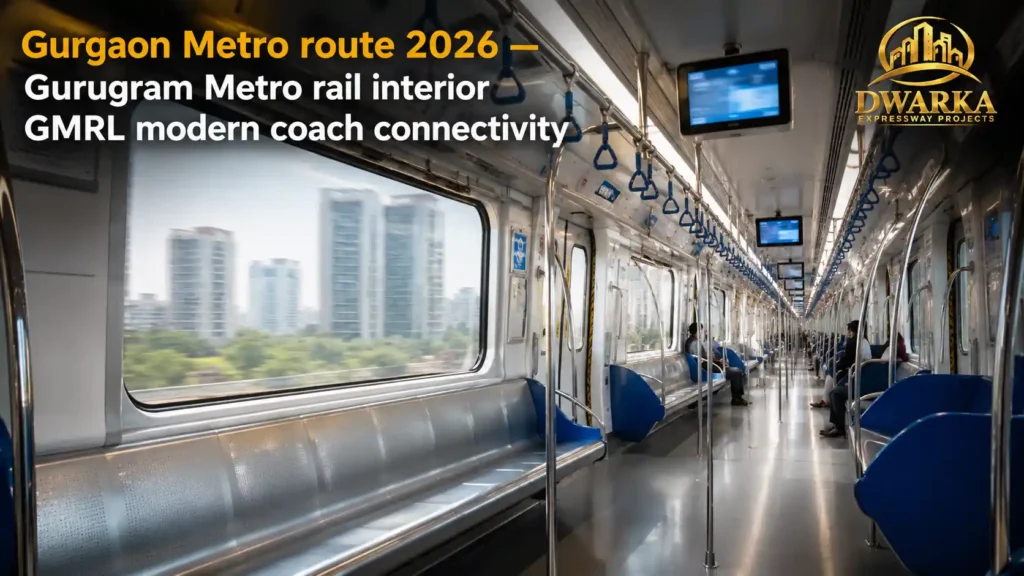
- Initially, 3-coach trains; upgradeable to 6 coaches
- Design speed 80 km/h
- The average operating speed is 34 km/h
Real Estate Impact of the Upcoming Metro Route in Gurgaon
Gurgaon Metro Real Estate Impact: What History and Data Tell Us
The coming metro line in Gurgaon isn’t just an infrastructure project. It’s a real estate price story. It is also clear.
The historical NCR metro data indicates that homes within a radius of 1-2 kilometers of metro stations are typically increased in value by 20-40% between the announcement of the construction and two years after the operation begins.
Additionally, Gurgaon’s rapid metro expansion proves this. During the time that it was the Rapid Metro was operational, segments that ran along Golf Course Road — Sectors 42, 43, and 54 — enjoyed a substantial growth in value compared to areas that did not have rail access.
Which areas will reap the greatest benefits from the metro line that is scheduled to be constructed and will be running in Gurgaon?
| Area | Distance to GMRL Route | Expected Benefit |
|---|---|---|
| Old Gurgaon (Sectors 3-10, 22-23) | Direct stations | Most high — completely unserved until now. |
| Palam Vihar | Direct station | Strong — huge residential population |
| Dwarka Expressway belt | 2-5 km (via Basai spur) | Significant connectivity — feeder + spur connectivity |
| New Gurgaon (Sec 82A-92) | Feeder accessible | Moderately — priced gradually |
| Golf Course Extension Road | Interchanges are accessible | Indirect boost — already premium |
The Old Gurgaon possibility: Old Gurgaon sectors were trading at a loss for many years because they were not equipped with a train connection to work centres only 5- 8 km away. Residents in Sector 9 who work within Cyber City today nneed40-60 minutes to travel by road. When the GMRL Metro line in Gurgaon is completed, the commute will be reduced to 20 minutes via the railway. This is a major shift in living standards and is not yet priced into property in Gurgaon.
Experts suggest: Properties in sectors directly affected by the Metro line that is scheduled to be built in Gurgaon could experience an increase of 15 to 25% before the first train is operational, just on the confirmation of the timeline of the infrastructure. This is known as the “announcement effect” that metro construction has consistently produced for Indian metros.
How the Upcoming Metro Route in Gurgaon Connects to Dwarka Expressway Projects
Metro Connectivity + Dwarka Expressway = Gurgaon’s Strongest Investment Case in 2026
The upcoming metro line in Gurgaon, as well as the Dwarka Expressway’s development, will be happening concurrently in 2026. Together, they create the most convincing residential investment plan within the NCR.
Here’s the complete infrastructure image:
Already delivered:
- Dwarka Expressway – fully in operation since 2024.
- Hospitals, schools, retail in Sectors 88A and the 89operational
- 18-20% annual price appreciation in the sectors 88A and 89
Coming in 2027-28:
- GMRL is the metro line that is coming to Gurgaon — the first trial run is scheduled in 2027.
- Basai spur linking to Sector 101 of the expressway
- Connectivity of feeders from expressway belts to GMRL stations
In the 3rd-7th year:
- Manesar Metro line (DPR completed, awaiting Central approval) – 35 kms away from Sector 56 and Panchgaon with a route that passes through Global City and IMT Manesar
- Global City employment hub – 10,000 acres the largest planned commercial zones
All of them are speculation reports. For instance, the Dwarka Expressway is already operational. The GMRL Metro Line that is planned for Gurgaon is in active pillar construction currently. The Manesar metro is in the process of finalizing its DPR. Each of these is driving the demand for residential projects that are located along the belt of expressways.
Laburnum Developers‘ active projects on Dwarka Expressway are located at the intersection of all these tailwinds for infrastructure:
Victory Floors Sector 89 — Best Positioned for Metro Impact
Configuration: 4 BHK | Size: 1,647-4,770 sq. ft | From: Rs 2.35 Cr. Sector 89 has seen 20% or more year-over-year growth. The metro spur towards Dwarka Expressway is expected to further decrease the hassle of getting to work, which was the sole issue for buyers when comparing this route to Golf Course Extension Road.
Victory Floors Sector 88A — Spacious 4 BHK at 18%+ Appreciation
Configuration: 4 BHK | Size: 2,043-3,150 sq. ft | From: Rs 33 Cr. Sector 88A is one of the best-established social infrastructures along the belt of expressways. Metro connection initially through a feeder route to Basai and then directly as the network grows will strengthen the long-term viability substantially.
Laburnum Homes Sector 82A — Best Entry Point, Metro Tailwind Ahead
Configuration: 3 BHK + Toilet Dimensions: 1,080-1,600 sq. ft | From: Rs 1.70 Cr Sector 82A is located in the middle of an expressway and is expected to benefit from similar metro connectivity upgrades as 88A and 89 and at the most accessible starting price within the Laburnum portfolio.

Comparison: Upcoming Metro Route in Gurgaon vs Current Metro Coverage
| Metro Line | Length | Stations | Status | Key Areas Covered |
|---|---|---|---|---|
| Delhi Metro Yellow Line | 5.3 km | 5 | Operational | MG Rd, Golf Course Rd, Sikanderpur |
| Rapid Metro Gurgaon | 11.7 km | 11 | Operational | Cyber City, Golf Course Rd, Sec 42-56 |
| GMRL Phase 1 (upcoming) | 15.2 km | ~15 | Under construction | Old Gurgaon, Palam Vihar, MCC |
| GMRL Phase 2 (upcoming) | 13.3 km | ~12 | Tenders stage | Udyog Vihar, Cyber City loop |
| Dwarka Expressway Spur | 1.85 km | 1 | Planned (within GMRL) | Basai to Sector 101 |
| Manesar Line (planned) | ~35 km | ~28 | DPR completed | SPR, Global City, IMT Manesar |
The scale is evident from this chart. Gurgaon is currently home to 17 km of metro. The metro line planned for Gurgaon alone will increase the number to 30+ kilometers. This will nearly double the rail network of the city within a single plan.
What Buyers and Investors Should Do Now
Acting Before the Upcoming Metro Route in Gurgaon Is Priced In
The pattern is the same across all Indian metropolises. The price of property is influenced by three phases:
Phase I — Announcement construction start: Early buyers capture the biggest appreciation timeframe. Properties in the corridor receive an increase of 10-20%.
Phase 2 — Moving towards operation: As trial runs are announced, another 15% appreciation is normal.
3.- Operation begins: Prices stabilise at the new high level. Buyers who wait until metro lines are in operation will enjoy the commute’s benefits, but they will miss the majority of the gains.
The Metro line that is planned for Gurgaon began Phase 1 in September 2025, with the foundation stone being laid and in active construction. Gurgaon is located in an area that is in the largest growth window in the world right now.
Additionally, those who purchase Dwarka Expressway projects, which have an impressive appreciation of 14-20% annually, enjoy an added benefit. The expressway is operational, as is the Metro on its way. Both catalysts increase in tandem.
The checklist for investors before purchasing:
- Verify DTCP-sanctioned plan for the project
- Confirm road width ≥ 10m from the plan (Stilt+4 compliance)
- Check HRERA registration at hrera.org.in
- Calculate distance from the project to the nearest GMRL station or Basai spur
- Use construction-linked payment plan — not time-linked
- Visit a completed project by the developer before booking
Frequently Asked Questions: Upcoming Metro Route in Gurgaon
Q. What is the planned metro route that will be running in Gurgaon?

The planned metro line located in Gurgaon will be that of the 28.5-kilometer GMRL loop, which runs from Millennium City Centre to Cyber City through 27 stations, as well as the 1.85-kilometer Dwarka Expressway extension. The foundation stone was laid in September 2025. Trial runs are scheduled for early 2027. Full operations are expected to begin in 2027-28. Total cost for project: Rs 5,452.72 crore.
Q. When will the new Gurgaon Metro be open?
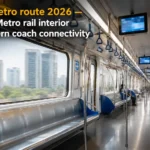
The first phase of the planned metro line in Gurgaon will have trial runs by early 2027 and commercial operation by late 2027 or in early 2028. Phase 2 tenders began in 2026, with full service being completed 18-24 months later. Its Dwarka Expressway spur forms a part of Phase 1.
Q. What sectors does this Gurgaon Metro 2026 route cover?

Gurgaon Metro stations will serve Old Gurgaon (Sectors 3-10, 22, and 23), Palam Vihar, Sector 47, Udyog Vihar, Cyber Park, Cyber City, and Millennium City Centre. Sector 47, Cyber City, and Udyog Vihar. Dwarka Expressway spur reaches Sector 101. The majority of the Gurgaon metro route segments are not connected to the metro at present.
Q. What is the impact of the proposed metro line in Gurgaon on the price of property?

NCR metro data shows that properties within 1- 2 km of the new stations increase by 20-40% after construction begins until two years after operation. Gurgaon Metro real estate impact is expected to be 15-25% in the directly served sectors prior to trains operating. The older Gurgaon, along with Dwarka Expressway properties, benefits most.
Q. What happens when the Gurgaon Metro connects to the Dwarka Expressway?
Do you think it will?. The metro line that is being built in Gurgaon comprises the 1.85 km spur that runs from Basai towards Sector 101 -the first metro connection to part of the Dwarka Expressway belt. Skywalks and feeder buses coming from Sectors 82A, A88, and 89 will offer last-mile metro connectivity in Gurgaon in Phase 1.
Q. Is there a Gurgaon Metro route connecting to Manesar?
A 35-km Gurgaon Metro route from Sector 56 to Panchgaon via Global City and IMT Manesar is a completed DPR but is awaiting central approval. There is no timetable for construction, or the budget is set. The Manesar route is not connected to the GMRL Metro line that is planned for Gurgaon.
Q. What is the estimated cost of the forthcoming Gurgaon Metro project?
The Gurugram Metro project cost is Rs 5,452.72 crore, which covers the 28.5-kilometer GMRL loop with the 27 Gurgaon Metro stations, the Dwarka Expressway spur, as well as one depot. It is funded by the Haryana Government and the Central Government, which share the cost of this project through Gurugram Metro Rail Limited.
Q. What will the new metro line in Gurgaon help Dwarka Expressway property buyers?
The Basai spur of the forthcoming metro line in Gurgaon offers Dwarka Expressway buyers the first direct metro connection at Sector 101. Feeder connectivity will serve sectors 82A, 83, 88A, and 89. Metro connectivity in Gurgaon is a further boost to the 14-20% price increase within these expressway segments.
Gurgaon Metro Stations: A Closer Look at Key Interchange Points
Millennium City Centre to Cyber City Metro – Why This Corridor Changes Everything
It is the Millennium City Centre Cyber City Metro corridor forms the mainstay of the new metro line within Gurgaon. It connects two of Gurgaon’s most important nodes – that of the Delhi Metro interchange at Millennium City Centre and the Rapid Metro interchange at Cyber City.
Additionally, for the first time, the Metro line that is being built in Gurgaon will provide a direct train ride from Old Gurgaon’s residential neighborhoods up towards Cyber City without using road transportation. This is a journey that currently takes 45-60 minutes in a car and will take 20-25 minutes using the metro.
Stops at key points and the significance
Millennium City Centre (South Terminal) is the current Delhi Metro Yellow Line terminus. This is the Gurugram Metro project, which makes it a dual-line interchange – the yellow Line that connects Delhi, GMRL for all of Old Gurgaon, and Palam Vihar. Therefore, the residents of each GMRL station can now connect straight to the Delhi Metro system.
Sector 47 (Subhash Chowk) One of Old Gurgaon’s busiest intersections on the road. The coming metro line in Gurgaon provides this region with its first transit line. In addition, Sector 47 is next to the GCR corridor, providing a crucial connection point for Golf Course Extension Road commuters.
Hero Honda Chowk (Sector 33) is being planned as a future interchange for the Rapid Regional Transit System (RRTS). If the RRTS operating network expands, the station will become an RRTS-like transport hub that has three modes of transportation: GMRL, RRTS, and feeder roads.
Udyog Vihar Phase 6 One of the largest concentrations of manufacturing and IT firms. Nowadays, the employees here depend exclusively on public transport. This is because the Gurgaon metro stations located at Udyog Vihar will give this region access to mass transit in the very first instance. Additionally, it will strengthen the profile of rental tenants for residential properties that are available in Udyog Vihar.
Cyber City (North Terminal): The GMRL’s north terminus has an interchange with the Rapid Metro Gurgaon network. Thus, commuters who commute from GMRL stations can connect to their destination via the Rapid Metro and access Golf Course Road stations Sector 42, 4, 3, and 54 in Sikanderpur and Sikanderpur — with no travel on roads.
The Gurugram Metro Project: Governance, Funding, and Accountability
Who Runs the Gurugram Metro Project and How Is It Funded?
It is the Gurugram Metro project is run under a Special Purpose Vehicle (SPV) version which is the norm for the latest Indian metro railway infrastructure.
Gurugram Metro Rail Limited (GMRL) is the executor of the project. It is owned jointly by both the Central Government and the Haryana Government through HMRTC (Haryana Mass Rapid Transport Corporation). This structure of joint ownership provides the state with speed of execution and central-level discipline in funding.
The funding structure is: The Centre and Haryana state share the Rs 5,452.72 crore cost. In addition, viability gap financing mechanisms and possible fare-box revenue forecasts have been included in the DPR. This means that the financial model is more secure than those that are solely metro projects funded by the state.
What is the reason this model of governance is important for buyers of property: A centrally backed metro project is less at probability of delays indefinitely as compared to a government-only funded one. Involvement of authorities like the Ministry of Housing and Urban Affairs in approving the project adds an element of accountability to the institutions. In addition, the ongoing construction that can be seen on the ground, foundations of pillars being poured, and equipment being mobilized indicates that funds are flowing and that the Gurugram Metro project is not at a standstill at any time.
Metro Connectivity Gurgaon: How the Full Network Looks After GMRL Opens
What Metro Connectivity in Gurgaon Looks Like With GMRL Operational
Metro connectivity in Gurgaon, following the GMRL, the metro line opens, will appear completely different than the present. Here’s the full image.
Today (2026):
- Delhi Metro Yellow Line: Five stations that cover MG Road, Sikanderpur, IFFCO Chowk
- Rapid Metro: 11 stations that cover Cyber City as well as Golf Course Road sectors
- Rest of Gurgaon There is no metro
After GMRL Phase 1 (2027-28):
- GMRL Loop adds 27 stations across Old Gurgaon, Palam Vihar, Sector 47, Udyog Vihar, Cyber City
- Basai Spur adds 1 station at Sector 101, Dwarka Expressway
- Triple interchange hub in Millennium City Centre (GMRL + Yellow Line)
- Two interchanges at Cyber City (GMRL + Rapid Metro)
After Manesar Line (future, if approved):
- Sector 56 to Panchgaon via SPR, Global City, IMT Manesar
- Quadruple interchange potential at Sector 56 node
For those who are buying property, the progression map is a good investment strategy. Each phase that is approved and constructed adds an additional layer of connectivity for properties that are located near the network. The coming metro line in Gurgaon that is entering Phase 1 operation is just the first phase of this upgrade in multiple phases.
New Metro Line Gurgaon: What Buyers Ask and What Experts Say
Real estate experts who track the metro line that is being built in Gurgaon always point out one thing: the most lucrative returns go to buyers who purchase before the line is operational, not when it’s finished.
The reason is simple. Prior to the opening of a metro, you pay a price that is based on the confirmed infrastructure, not operational realities. Once it’s opened, the price increases dramatically, but then stabilizes. The most significant appreciation window occurs between 18 and 24 months before the first operation starts. That is precisely the location where the Metro line that is scheduled to open in Gurgaon Phase I is located at present.
In addition, new metro line Gurgaon projects typically see more rapid capacity absorption. Developers located in metro-adjacent areas have reported shorter timeframes from booking to sale. Thus, buyers who purchase new launches in those along the GMRL area — which includes Laburnum’s developments — benefit from both appreciation of prices and lower risk of vacancy when renting.
The particular sectors to watch:
- The old Gurgaon (Sectors 3-10, 2,2 3): Biggest undervaluation with respect to the proximity of employment. Indirect GMRL stations. The highest potential for revaluation.
- Palam Vihar: A large residential area with direct access to stations and currently commutes up to 40+ minutes to Cyber City via road.
- Sector 47 (adjacent to the GCER) benefits from both GMRL connectivity and closeness to the Golf Course Extension Road.
- Basai Sector 101: Entry point for the Dwarka Expressway spur. Metro connectivity will be enhanced immediately after the spur is officially commissioned.
Gurgaon Property Investment Checklist: Acting on Metro Connectivity
Before You Buy Near the Upcoming Metro Route in Gurgaon
| Check | What to Verify | Why It Matters |
|---|---|---|
| DTCP Plan that has been approved | Physical document, stamp of the government, reference number | Confirms that legal construction floors are in place and road width |
| Road width greater than 10m | Verified using DTCP plan, not a visual estimate | The requirement for Stilt+4 is in the Haryana Building Code 2024 |
| HRERA registration | Check at hrera.org.in — active status + no complaints | Your money is protected by 70% escrow and possession date |
| Status of OC | Physical OC from MCG for projects that are ready to move | Requirements for approval of a home loan |
| The distance from GMRL station | Verify the proximity of recently announced Gurgaon Metro stations. | Closer = higher appreciation trend |
| Developer delivery record | Visit a finished project and talk to residents | Past delivery = the most reliable indicator of the future of delivery |
| Construction-linked payments | Installment linked to milestones in construction | Helps to prevent projects from getting stuck |
| All-in cost | Basis + GST (5 5 %)) + Stamp duty (7%/5 5%)) + registration (1 percent) | Prevents post-booking cost surprises |
The Upcoming Metro Route in Gurgaon Is a Once-in-a-Generation Infrastructure Event
Gurgaon has waited a long time waiting for this. The Metro line that is scheduled to be built in Gurgaon will fill the largest gap in its infrastructure, one that has kept Old Gurgaon undervalued and Dwarka Expressway areas isolated from the metro system.
The gap is closing. Construction is visible on the ground. The GMRL is working. The timelines are precise. The property market is beginning to realize what was once just an assurance.
If you are a buyer looking at residential developments located in Gurgaon by 2026, the story of infrastructure has never been better. In fact, the Dwarka Expressway is fully operational. The planned metro route to Gurgaon is currently under construction. Global City is coming. Property prices, despite increasing, are significantly lower than those on Golf Course Extension Road for comparable qualities.
Laburnum Developers’ projects across Sectors 63A, 82A, and 89 place purchasers directly within the direction of these tailwinds in infrastructure and all with complete DTCP compliance, a proven credibility of the developer, and clear documentation starting from the beginning.
Explore All Laburnum Projects – View Dwarka Expressway Projects – Contact Our Team –
Read Also.. Top 10 Residential Projects in Gurgaon 2026: Buyer’s Guide